A shopkeeper allows a 25% discount on the marked price of an article and incurs a 10% loss. If the marked price of the article is ₹180, find the cost price of the article.
Answer & Solution
Correct option is B
Get Profit AND Loss Questions FOR Bank Exams to prepare for your upcoming exam. Solve the most expected questions and detailed solutions that can be asked in the exam.
A shopkeeper allows a 25% discount on the marked price of an article and incurs a 10% loss. If the marked price of the article is ₹180, find the cost price of the article.
Correct option is B
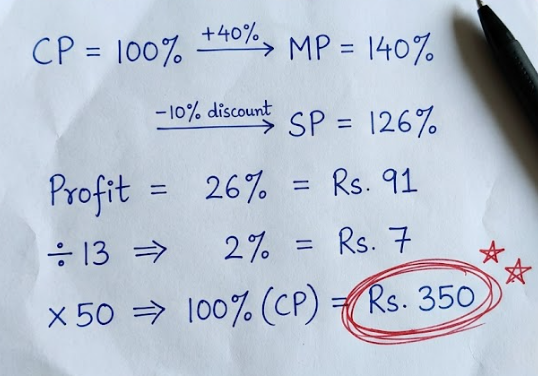
A shopkeeper marks an article 40% above the cost price and gives a discount of 10%. If the profit earned is Rs 91, find the cost price of the article (in Rs).
Correct option is B

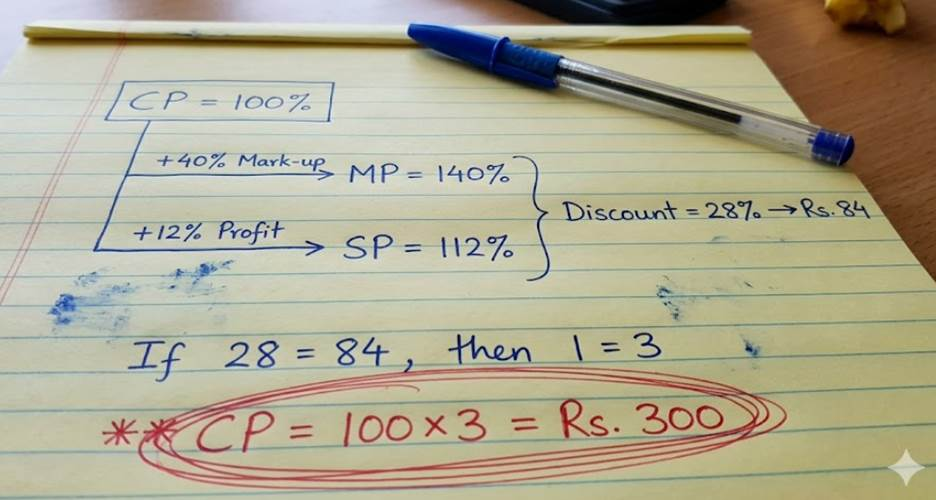
A trader marked a watch 40% above its cost price and earned a profit of 12% after giving a discount. If the discount given on the watch is Rs. 84, then find the cost price of the watch.
Correct option is B

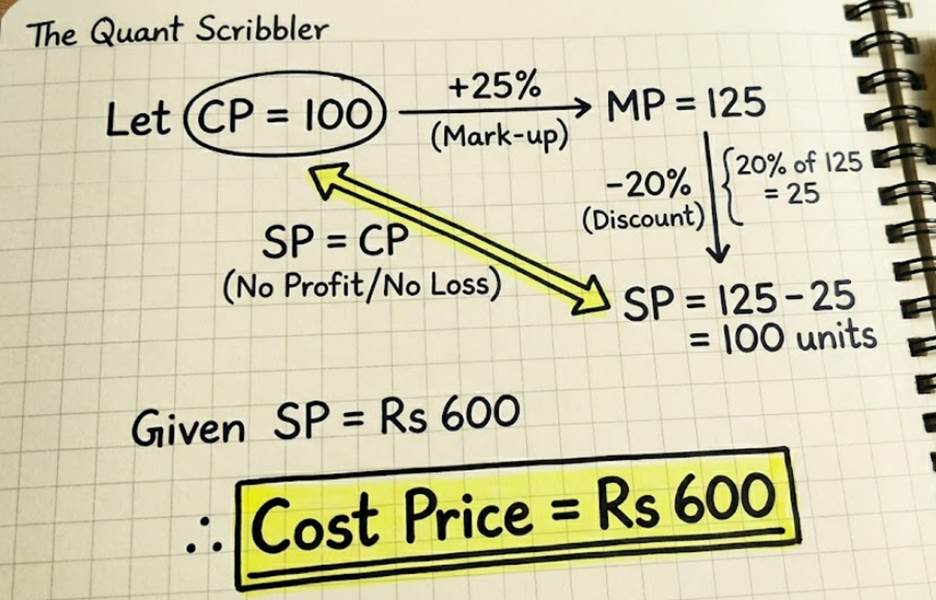
The marked price of an article is 25% above the cost price and the shopkeeper allows a discount of 20%. If the article is sold for Rs 600, find the cost price of the article.
Correct option is D

The cost price of a table and a chair together is Rs 400. The table is sold at a profit of 25% and the chair is sold at a profit of 25%. Find the total selling price (in Rs) of both items together.
Correct option is A
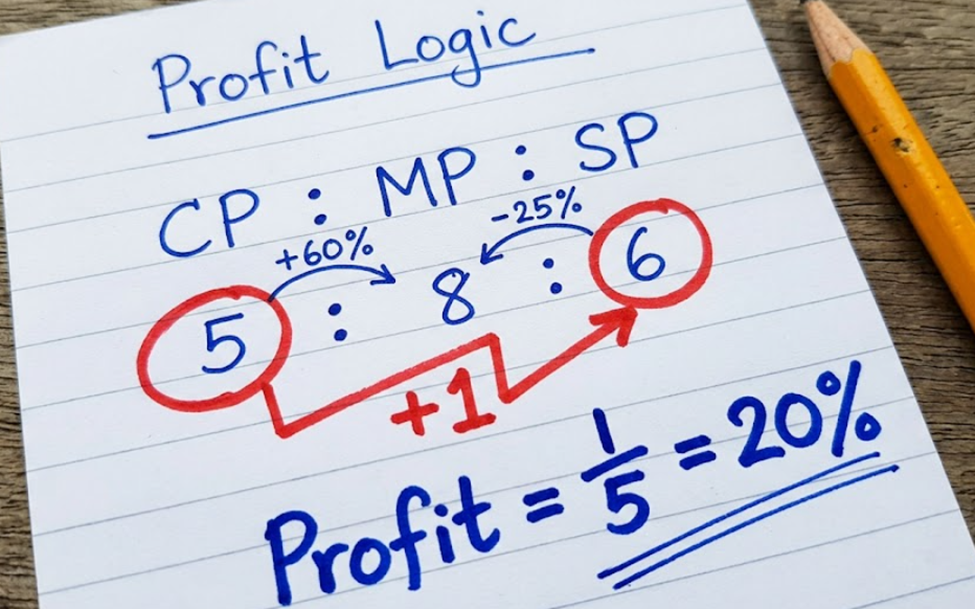
A shopkeeper marks an article 60% above cost price. He gives a discount of 25%. Find the profit percentage.
Correct option is B

Correct option is A
Information Given in the Question:
First person buys at ₹1000.
Sells at 20% profit.
Second person sells at 10% loss.
Need to find overall profit or loss % compared to original cost price (Rs 1000).
Concept/Formula Used in the Question:
Selling Price (SP) = Cost Price (CP) × (1 ± Profit/Loss%)
Overall Profit or Loss = Final SP - Original CP
Percentage Profit or Loss =
Detailed Explanation:
First person bought at Rs 1000
Sells at 20% profit = SP = 1000 × 1.20 = Rs 1200
Second person bought at Rs 1200
Sells at 10% loss = SP = 1200 × 0.90 = Rs 1080
Final Selling Price = Rs 1080
Original Cost Price = Rs 1000
Profit = 1080 - 1000 = Rs 80
Profit % = × 100 = 8%
Short Exam Hall Approach:
Rs 1000 → +20% → ₹1200
Rs 1200 → -10% → ₹1080
Compare final SP Rs 1080 with original CP Rs 1000
Profit = Rs 80 = 8%
The cost price of a watch is Rs. 750 and a bag is Rs. 840. A shopkeeper sold the watch at profit of 20% and the bag at loss of 15%. Find the overall profit or loss received by the shopkeeper (in Rs.)?
Correct option is D
Information Given:
Cost price of watch = Rs. 750
Cost price of bag = Rs. 840
Watch sold at 20% profit
Bag sold at 15% loss
Concept/Formula Used:
Profit/Loss = Selling Price – Cost Price
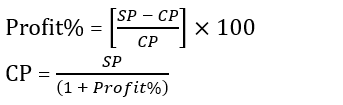
Profit% = (Profit / Cost Price) × 100
Selling Price (SP) at profit = CP × (1 + Profit%)
Selling Price (SP) at loss = CP × (1 – Loss%)
Overall profit/loss = Total SP – Total CP
Explanation:
SP of watch = 750 × 1.20 = Rs. 900
SP of bag = 840 × 0.85 = Rs. 714
Total cost price = 750 + 840 = Rs. 1590
Total selling price = 900 + 714 = Rs. 1614
Overall profit = 1614 – 1590 = Rs. 24
Correct option is D
Information Given:
Selling price (actual) = Rs. 800
The article was sold for Rs. 60 more.
This new selling price is 25% more than the cost price.
Formulas Used:
Profit = Selling Price - Cost Price
Basic Explanation:
We are told that if the article were sold for Rs. 860, the selling price would be 25% more than the cost price.
Let the cost price be C.
860 = C + 0.25C
C =
C = 688
Profit = 800 - 688 = 112
Profit Percentage = = 16.2%
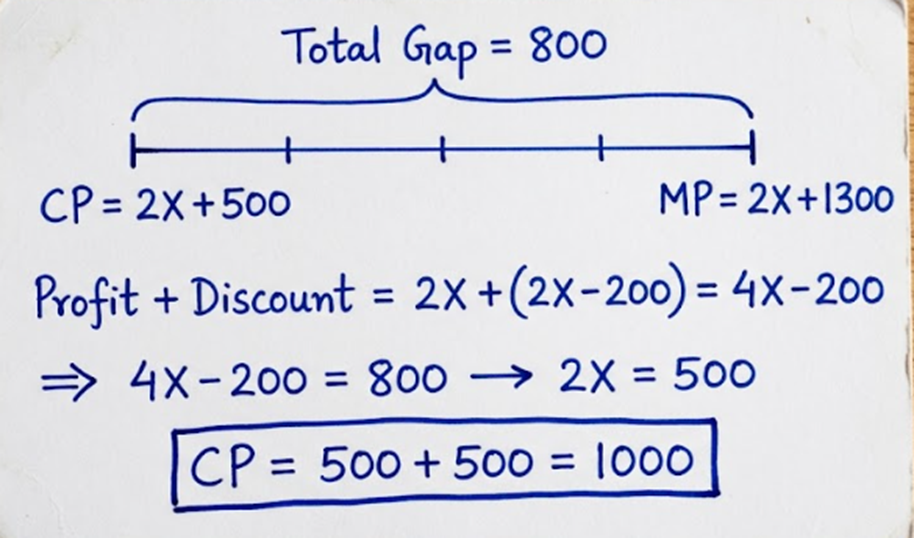
The cost price of an article is Rs. 2X + 500 and marked price of the article is Rs. 2X + 1300. If the profit and discount on that article is Rs. 2X and Rs. 2X – 200, then find the cost price of the article Iin Rs.)?
Correct option is C
Information Given:
Cost price = Rs. 2X + 500
Marked price = Rs. 2X + 1300
Profit = Rs. 2X
Discount = Rs. 2X – 200
Formula Used:
Discount = Marked Price - Selling Price
Profit = Selling Price - Cost Price
Explanation:
ATQ, 2X = Selling Price – (2X + 500)
Selling Price = 2X + 2X + 500 = 4X + 500 Rs.
Also, 2X - 200 = (2X + 1300) - (4X + 500)
2X - 200 = 2X + 1300 - 4X - 500
2X - 200 = -2X + 800
2X + 2X = 800 + 200
4X = 1000
X = 250
So, cost price of the article = 2×250+500 = 1000 Rs.
Exam Hall Approach

The selling price of an article becomes Rs.1080 after giving two successive discounts of x% and 25% and marked price of article isRs.1800. Find the cost price of article if there is a profit of x% on selling the article after giving two successive discounts?
Correct option is D
Information Given:
Marked Price (MP) = ₹1800
Two successive discounts: first x%, then 25%
Selling Price (SP) after both discounts = ₹1080
Profit on selling the article = x%
Find the Cost Price (CP)
Concept/Formula Used:
Successive discounts: SP = MP × (1 − x/100) × (1 − 25/100)
Profit% relation: SP = CP × (1 + x/100)
Explanation:
80= (100 - x)
x= 20
An article is sold at Rs. 600 and results in a loss of 25%. If the same article is marked 25% above cost price and sold at a profit of Rs. 150, then find the new selling price (in Rs).
Correct option is C
Information Given:
Selling price with 25% loss = Rs. 600
In the second case:
Marked price = 25% above cost price
Profit = Rs. 150
Formulas Used:
Loss% =
Marked Price (MP) = CP + % Markup
Selling Price = Cost Price +Profit
Basic Explanation:
Cost price = = Rs 800
Marked Price = 800 + 25% of 800 = 800+200 = Rs 1000
New Selling Price = 800 + 150 = Rs 950
The cost price of article A is Rs.150 less than that of article B. Articles A and B marked up by 20% & 50% above the cost price respectively. If he ratio of marked price of article B and A is 25:14. Find the cost price of B.
Correct option is D
Given:
Cost price of article A = Cost price of B - 150
Articles A and B marked up by 20% & 50% above the cost price
marked price of article B : A = 25:14
Explanation:
Let the cost price of A be Rs.x - 150
Cost price of B be Rs. x
ATQ,

10(x-150) = 7x
10x – 1500 = 7x
3x = 1500
500 = x
Correct option is A
A shopkeeper mixes white rice and brown rice with a cost of Rs. 90 per kg and Rs.144 per kg. If he sells the mixture of Rs. 168 at 40% profit, then find at what ratio he mixes white rice and brown rice?
Correct option is A
Information Given:
Cost price (CP) of white rice = Rs. 90/kg
CP of brown rice = Rs. 144/kg
Selling price (SP) of mixture = Rs. 168/kg
Profit on mixture = 40%
Asked: Ratio of white rice : brown rice
Concept/Formula Used:

Alligation rule:
Cheaper : Dearer = (Dearer - Mean price) : (Mean price - Cheaper)
Explanation:
CP of mixture = 168× (100/(100+40))
= 168× (100/140) = 120 Rs.
By Apply alligation between Rs. 90 and Rs. 144 to get mean 120:
Cheaper : Dearer = (144 - 120) : (120 - 90) = 24 : 30 = 4 : 5